Strengthening municipal execution for sustainable impact
By Thinasiviwe Dlulane

Communities do not experience strategy documents. They experience what happens when plans reach everyday life.
A road that is maintained, a public space that functions, a service that is delivered consistently, or a local economy that creates room for participation can make an abstract plan feel tangible. The reverse is also true: when implementation stalls, strategy can quickly feel disconnected from lived experience.
In my view, this is where the municipal conversation needs to become more practical. The question is not only whether a municipality has the right priorities, but whether those priorities are connected to the resources, capabilities, decisions and actions required to move them forward.
The real challenge is therefore less about producing another plan and more about closing the gap between intention and execution: deciding what matters, aligning the available resources, giving people clarity on their roles, tracking progress and learning from what the results are showing.
The true measure of a strategy is not whether it exists. It is whether it delivers.
The gap between planning and doing
Municipal planning brings together priorities, budgets, projects, institutional responsibilities and the expectations of communities. In my view, the value of that planning is realised only when these elements speak to one another.
A priority should lead to a decision. A decision should connect to a practical action. That action should have ownership, resources and a way of understanding whether progress is being made. Without those connections, even a well-considered strategy can remain just that—a strategy.
This is the discipline I believe deserves greater attention: creating a visible line from strategic intent to practical action and, ultimately, to the change the municipality is trying to achieve.
Financial sustainability is part of execution
Financial sustainability should not be viewed as a conversation separate from delivery. In my view, financial decisions shape what can realistically be prioritised, sequenced and sustained over time.
That means financial thinking has to sit alongside strategic thinking. The conversation becomes more useful when priorities are considered alongside available resources, competing demands, long-term commitments and the capacity to maintain what is built or introduced.
The point is not simply to focus on financial performance in isolation. It is to understand how financial choices affect the ability to turn priorities into durable outcomes.
Transformation does not happen in silos
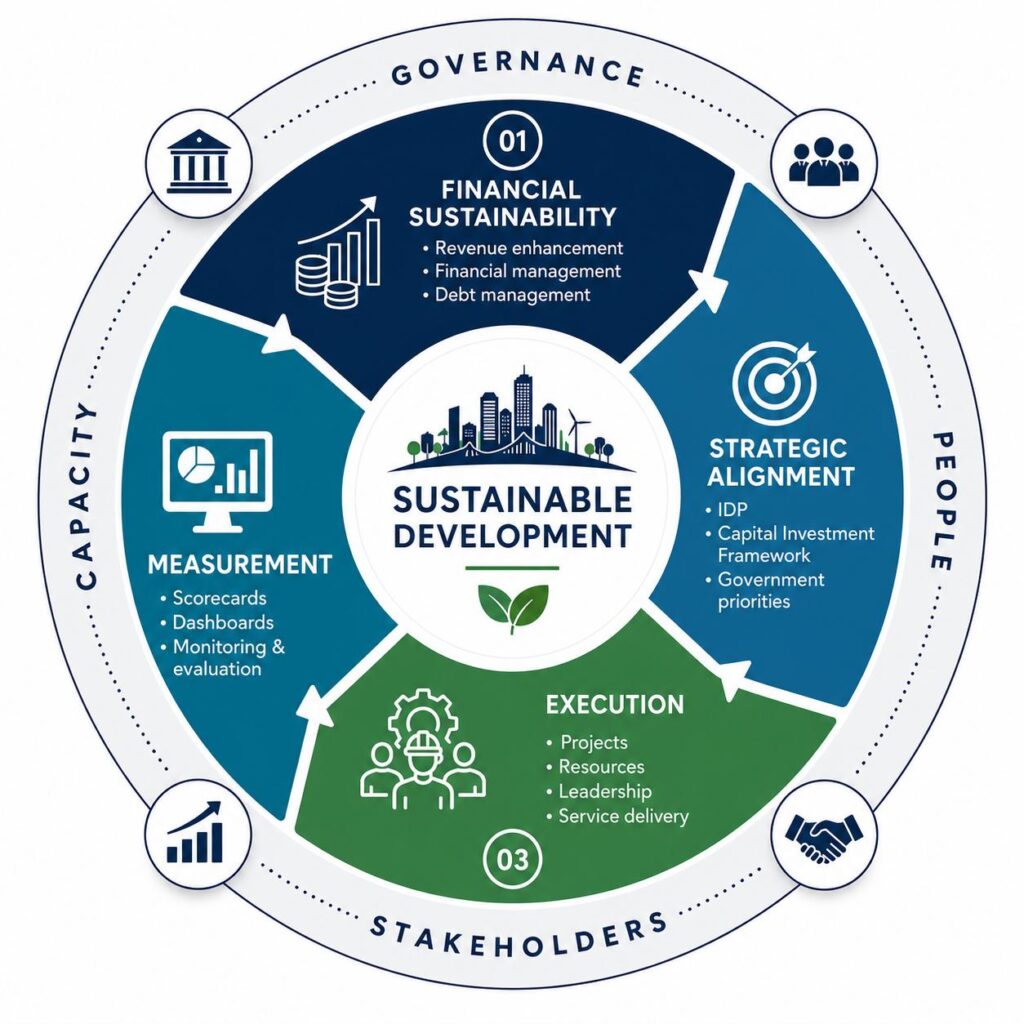
I believe municipal performance is best understood as an interconnected system. Finance affects what can be prioritised. Organisational capability affects what can be executed. Governance affects how decisions are made and followed through. Local economic development and service delivery are, in turn, shaped by all of these conditions.
This matters because improving one part of the system does not automatically improve the whole. The more useful question is how the different parts reinforce—or constrain—one another.

Execution is where strategy earns its value
A strategy becomes meaningful when people know what it requires of them and when progress can be seen. That calls for ownership, coordination, communication, sensible resource allocation and accountability—not as separate activities, but as parts of the same execution discipline.
For me, the practical test is simple: can someone trace a priority from intention to action, see who is responsible, understand what progress looks like and learn from the results?
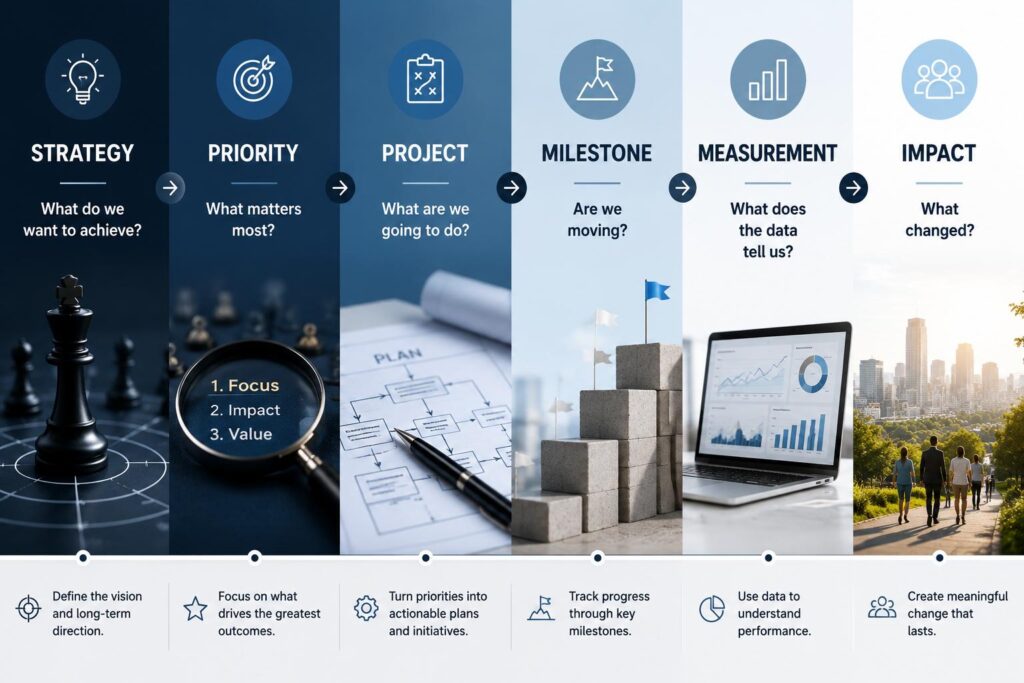
Strategy → Priority → Project → Milestone → Measurement → Impact
The discipline of execution is the bridge between what a municipality intends to achieve and what communities ultimately experience.
People make execution possible
No strategy implements itself. People interpret priorities, make decisions, manage competing demands and carry the work forward.
That is why organisational capability matters. Leadership, skills, roles, systems, processes and working relationships all influence whether a strategy can move beyond the page. A strong execution culture is therefore not only about having capable individuals; it is about creating enough clarity and alignment for people to act collectively.
I also think this is where leadership matters most: creating the conditions for people to take ownership, surface obstacles early and remain focused on outcomes rather than simply completing activities.
Communities should remain at the centre
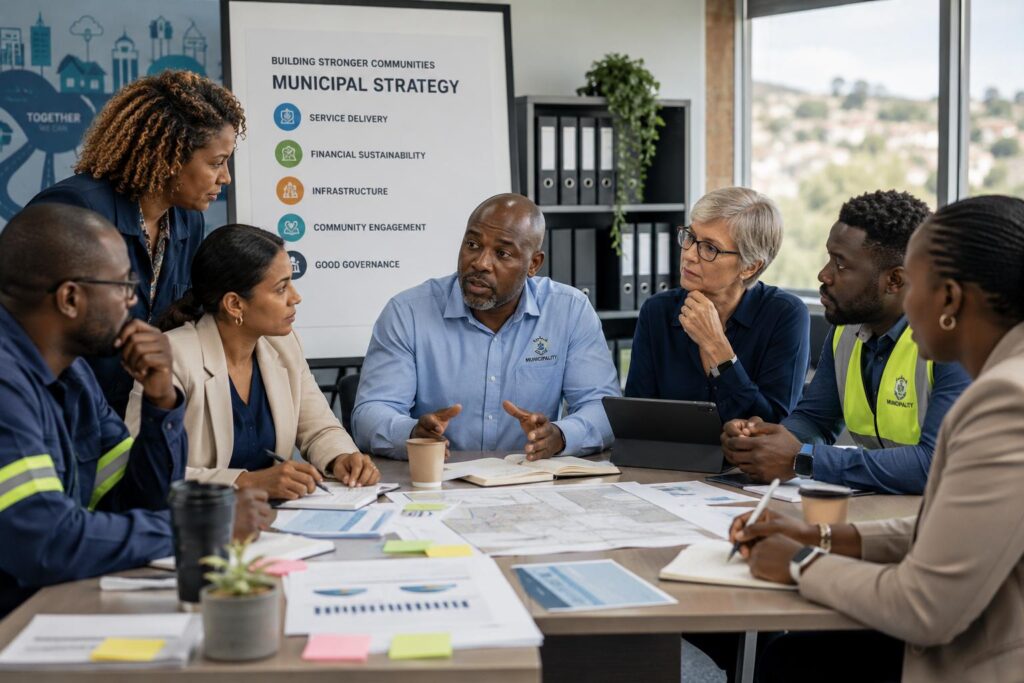
Ultimately, municipal performance should be judged by what it means in people’s everyday lives. That makes engagement more than a procedural step. It is part of understanding whether priorities remain relevant, practical and connected to the realities they are intended to address.
In my view, the strongest approach is one that treats communities as part of the development conversation— not simply as the recipients of its eventual results. Listening, communicating and learning along the way can strengthen the connection between plans and lived experience.
Sustainable transformation cannot simply be done to communities. It must be built with them.
Measure what matters
Execution also requires a clear view of what progress actually means. A list of activities can tell us what has been started; it does not necessarily tell us what has changed.
A more useful perspective is to look across the dimensions that influence municipal performance and ask how they connect to the outcomes that matter. The measures will differ by context, but the principle is consistent: measurement should help people make better decisions, not simply produce more information.
This is where the conversation shifts from activity to impact. Starting a project is an event. Understanding whether it is moving a priority forward is a management question.
A different way to think about municipal performance
Perhaps the most important shift is conceptual. Municipal performance should not be approached as a series of isolated problems waiting for isolated solutions. It is better understood as an ongoing process of alignment, execution, feedback and adjustment.
That perspective also changes what we mean by transformation. Transformation is not necessarily a single programme, a new structure or another document. It can be the cumulative effect of making better connections between priorities, resources, people, decisions, measurement and outcomes.
There is no universal formula for doing this well. Each municipality operates within its own circumstances, constraints, opportunities and leadership context. What can be strengthened, however, is the discipline of execution.
The role of leadership is therefore not simply to approve plans, but to keep asking whether the organisation is translating those plans into purposeful action—and whether the evidence suggests that course corrections are needed.
Building sustainable capability
The longer-term opportunity, in my view, is to build the capability to plan, prioritise, execute, measure and adapt continuously. That is more sustainable than treating every challenge as a standalone intervention.
Every municipality has its own context and developmental journey. There is no single template for transformation. But there can be a consistent commitment to closing the distance between strategy and reality: connecting priorities with resources, plans with action, leadership with accountability, and measurement with learning.